Your agents write Markdown all day.
Read it before it becomes history.
Claude Code, Cursor, Codex — every run leaves plans, reports, READMEs and
CLAUDE.md edits behind. Someone still has to be the editor.
The new pile of prose
An agent finishes, and the repo has six changed files: a plan, a report, two doc
edits, a new README section, a tweaked CLAUDE.md. In the terminal
that's a wall of +/− noise; in a code editor it's raw
markup. So most of it gets skimmed — or merged unread — and the project's history
slowly fills with words nobody actually read.
That's the gap bare sits in: a quiet review desk where agent-written Markdown is read the way it was meant to be read, and committed the way changes ought to be committed — deliberately.
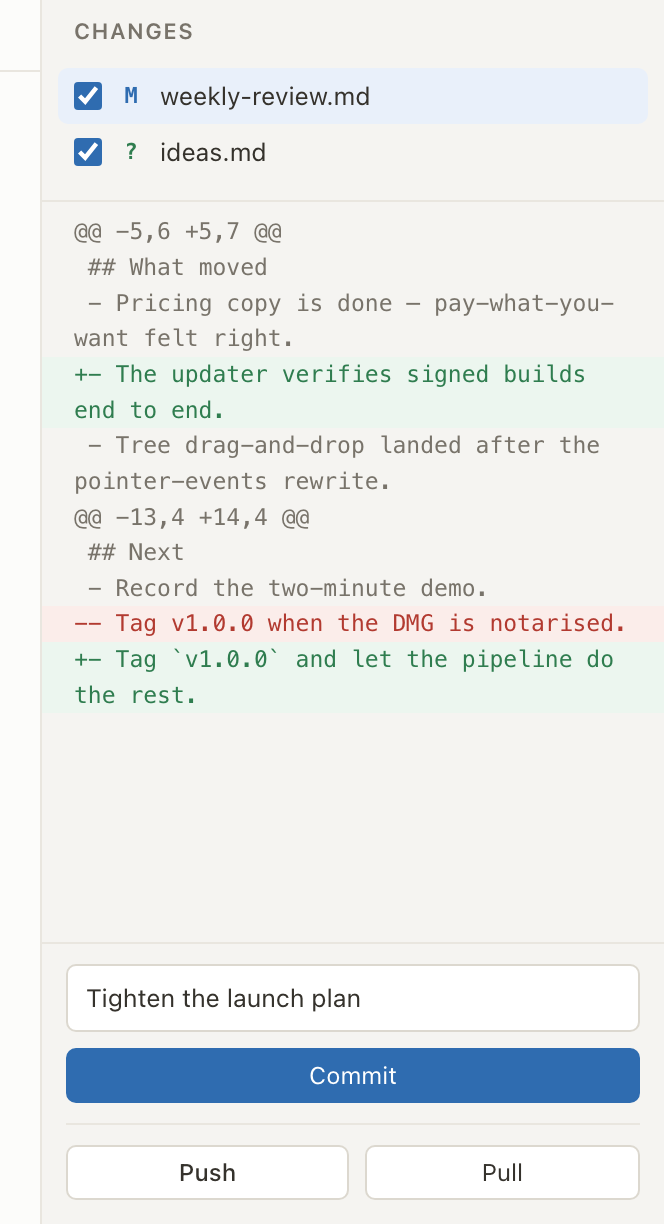
See exactly what
the agent did.
bare watches the folder — as the agent saves, changed files surface in the Changes pane. Each file has a unified diff: exactly what was added, removed, reworded. And the result reads as a rendered page — headings, tables, the actual document — not markup.
- Tick only the files that deserve to land — never a blanket
git add -A. - Write the commit message the work actually deserves.
- Discard what didn't earn its place — nothing lands in history without you.
- Pull agent commits from a remote explicitly, fast-forward-only.
Safe to open output you didn't write
Agent output is untrusted input. bare treats it that way: rendered HTML is sanitised, remote content — images, scripts, styles — is blocked by default with a per-file opt-in, and links open in your browser, never inside the app. A tracking pixel or script tag smuggled into a generated README simply doesn't load or run on your reading desk.
No AI inside — deliberately
bare doesn't write, summarise, autocomplete or generate anything, and it never will quietly. It's the human half of the loop: the agents produce; bare is where you read, judge, and decide what becomes part of the record. If you want AI inside your editor, bare isn't it — that's the point.
And because it's just files and Git, it works with whatever writes them: Claude Code, Cursor, Codex CLI, Aider, cron jobs, colleagues. No integration to install, no MCP server, nothing to configure.
Questions people ask
Does bare connect to Claude Code or other agents?
It doesn't need to. Agents write files; bare watches the folder and shows every change as a unified diff and a rendered page. No plugin, no MCP server, no configuration — it works with any agent that writes files, because it's just files and Git.
Can an agent commit through bare?
Not through bare — it never auto-commits or auto-pushes; commits happen when a person ticks files and writes a message. An agent with terminal access can always run git itself, of course — bare is where you keep the human checkpoint in front of that.
Is bare an AI Markdown editor?
No — deliberately. bare contains no AI features at all. It's the human half of the loop: the agents write, and bare is where you read what they wrote, judge it, and decide what becomes part of the record.
Put a desk between the agents and the record.
Download free, open the repo your agents work in, and read what they've been leaving you.
Download free for macOSHow bare's Git works · The reading experience · Privacy — every network call listed